What to bring to VCE exams, and what's banned (2026)
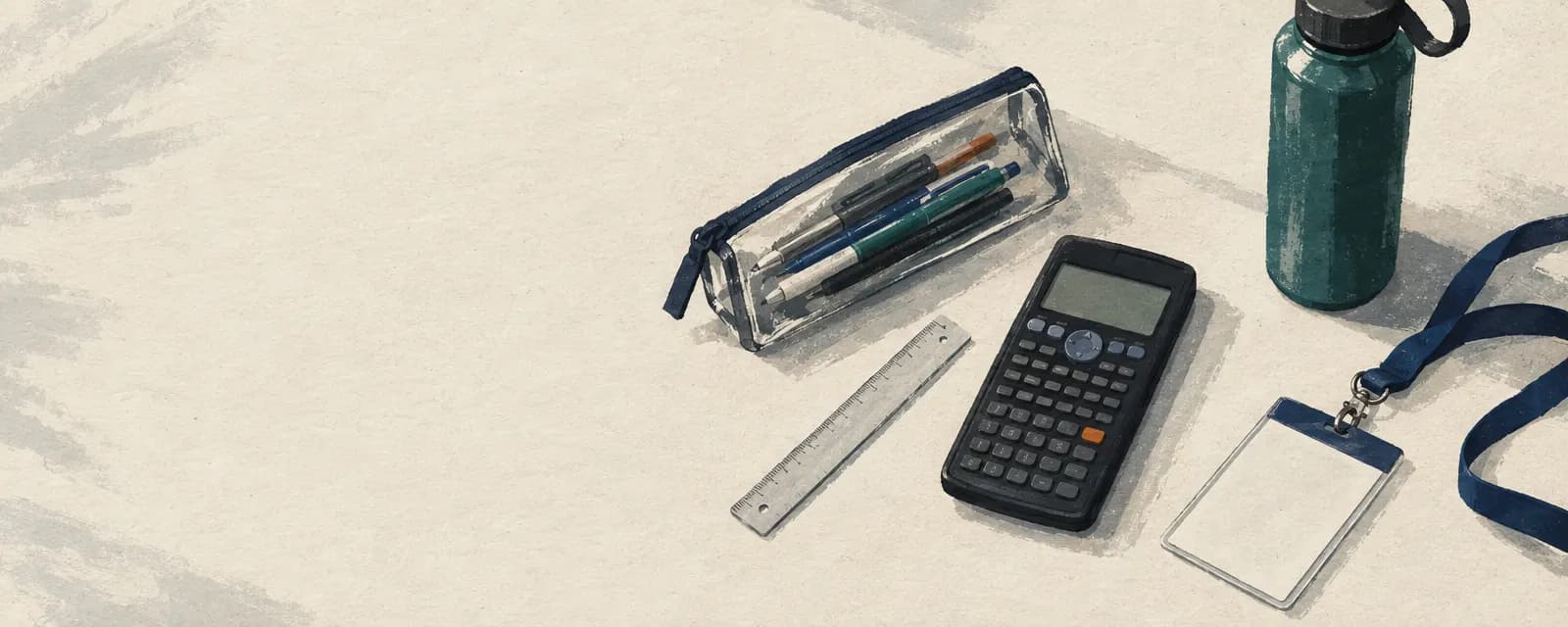
Bring pens, pencils (HB or 2B for multiple choice), highlighters, an eraser, a sharpener and a ruler in a transparent pencil case, one clear bottle of still water (labels off, 1500 mL or less, kept off the table), and the calculator, bound reference or dictionary your exam allows. Phones, smart watches, fitness trackers, notes, blank paper and correction fluid or tape are banned, and any plain watch must come off and sit at the top of your table (watches with an alarm or stopwatch function aren't allowed). Arrive at least 30 minutes early.
The main 2026 VCE written exam period runs from Tuesday 27 October (English and EAL) to Wednesday 18 November. Some Languages written exams are earlier, on 15 and 16 October, so check your own timetable. Everything below comes from VCAA's authorised materials list for 2026, its external assessment rules and the 2026 VCE Exams Navigator. If your school or VCAA tells you something different, follow them.
Your VCE exam kit
VCAA's "basic stationery" is:
- pens, pencils, highlighters, erasers, sharpeners and rulers.
For exams with a multiple-choice section, bring an HB or 2B pencil and an eraser.
A pencil case is only allowed if it is transparent.
- Water
- one clear plastic bottle of still water, with all labels removed, a secure lid and no more than 1500 mL. It must never go on your table, and you can't refill it or share it. No other food or drink is allowed unless VCAA has approved it.
- Asthma inhaler
- allowed without special approval. Put it at the top of your table. Other medication should only be taken as part of approved Special Examination Arrangements.
- Identity
- your identity is checked as you enter, either by a staff member from your school or with photo ID. Your answers are identified by your VCAA student number, which is on your Student Examination/Assessment Timetable.
Things that are not basic stationery (so only bring them if your exam allows them): curve-sketching aids, Mathomat, MathAids, compasses, set squares, protractors, scale rulers, correction fluid or tape, and loose paper.
Calculators
- Scientific calculators (no graphing, symbolic or programming capability) are allowed in exams including Accounting, Chemistry, Economics, Environmental Science, Foundation Mathematics, General Mathematics, Mathematical Methods Exam 2, Physics, Specialist Mathematics Exam 2 and Systems Engineering, among others. Check VCAA's list for your study.
- VCAA-approved CAS calculators are allowed only in General Mathematics Examinations 1 and 2, Mathematical Methods Examination 2 and Specialist Mathematics Examination 2. You can use their full functions, and memories don't need to be cleared.
- Your calculator must be silent, handheld and use its own power. No portable chargers. Bring your own spare batteries: VCAA won't take a technical fault or flat battery into account, and you can't borrow a calculator from another student once you're in the room.
Bound references, notes sheets and dictionaries
- Bound reference (Foundation Mathematics, General Mathematics 1 and 2, Mathematical Methods Exam 2, Specialist Mathematics Exam 2): a book of A4 size or smaller when closed, with permanently bound pages and a single spine. You can annotate it. Not allowed: ring binders, plastic sleeves, sticky notes, removable tabs or pages designed to come out. If a page comes loose, the supervisor removes it and reports it as a potential breach, so check yours now.
- Methods and Specialist Exam 2 also allow a protractor, set square and curve-sketching aids.
- Physics: one folded A3 sheet, or two A4 sheets taped together, of notes (typed or handwritten, one or both sides, from any source).
- Dictionaries: a printed English and/or bilingual dictionary is allowed in English and EAL, Literature, Classical Studies and Theatre Studies (and the GAT). Language written exams allow any printed monolingual and/or bilingual dictionary in one or two volumes. Dictionaries must have no highlighting, annotations or added tabs, no thesaurus, and can't be shared. Electronic dictionaries are banned, and dictionaries aren't allowed in Language oral exams.
- Design subjects have their own lists (for example, Visual Communication Design allows coloured pencils, fineliners up to 0.6 mm, set squares, protractors, compasses and circle and ellipse templates). Check VCAA's page for your study.
What's banned in the exam room
VCAA's list of what you can't bring includes:
- mobile phones;
- any electronic device, including smart watches and fitness trackers;
- correction fluid or correction tape;
- textbooks and notes (unless your exam specifically allows them);
- blank paper or loose sheets of paper.
Watches: you can't wear a watch of any type during a written exam. All watches must be taken off and placed at the top of your table, and a supervisor can tell you to remove one from your table if there's any doubt about its functions. Stopwatches, and watches with special functions such as an alarm or a stopwatch, aren't permitted in the room at all. Reading and writing times run off the clock in the exam room.
What happens if you break the rules?
- If you have a device that can store, receive or send information, you must hand it over when a supervisor asks. VCAA says confiscated phones and devices may be kept for up to 3 months.
- Supervisors can check what you've brought and remove anything that doesn't comply, and they report all alleged breaches to VCAA.
- If a breach is found, you're allowed to finish the exam, and you're told an incident report is being sent to VCAA.
- Penalties decided by a review committee range from a reprimand, to changing or cancelling your grade for that exam, up to cancelling all your grades for the year, including your certificate. Results can be withheld until a hearing.
Other rules include not talking to other students and not taking any response material (used or unused) out of the room.
When to arrive, and when you can leave
- Arrive at least 30 minutes before the start time.
- Most exams start with a 15-minute reading period, and it's included in the times on the timetable. Some Languages exams have 10 minutes, and Classical Hebrew and Classical Greek have 5.
- Up to 30 minutes late (after writing time starts): you're let in and get the full writing time, but no reading time.
- More than 30 minutes late: you're only let in if strict conditions are met, including a recommendation from the principal, and VCAA may not accept your answers.
- You can't leave before 30 minutes of writing time have passed, or in the last 5 minutes.
- At the end, stay seated and silent until your papers have been collected and checked.
Reading time rules in one line
During reading time you can read the instructions, the question book and any permitted dictionary or bound reference, but you must not write, mark your paper in any way, or use a calculator until writing time is announced. See how to use reading time well.
If something goes wrong
If you're sick or something happens around an exam, tell your VCE coordinator or the chief supervisor as soon as possible, see a health professional within the right window, and read what to do if you're sick during VCE exams to find out about the Derived Examination Score (DES).
Sources & how we know this
- Authorised materials and equipment for 2026 VCE external assessments — Victorian Curriculum and Assessment Authority (VCAA) (2026)
- VCE external assessment rules — Victorian Curriculum and Assessment Authority (VCAA) (2026)
- VCE Exams Navigator 2026: external assessments — Victorian Curriculum and Assessment Authority (VCAA) (2026)
- VCE examination timetable — Victorian Curriculum and Assessment Authority (VCAA) (2026)
- VCE Administrative Handbook: scored assessment (breaches of rules) — Victorian Curriculum and Assessment Authority (VCAA) (2026)
Last updated: 2026-09-28. Rules change. For the official source see VCAA.