What to bring to TASC exams, and what's banned (2026)
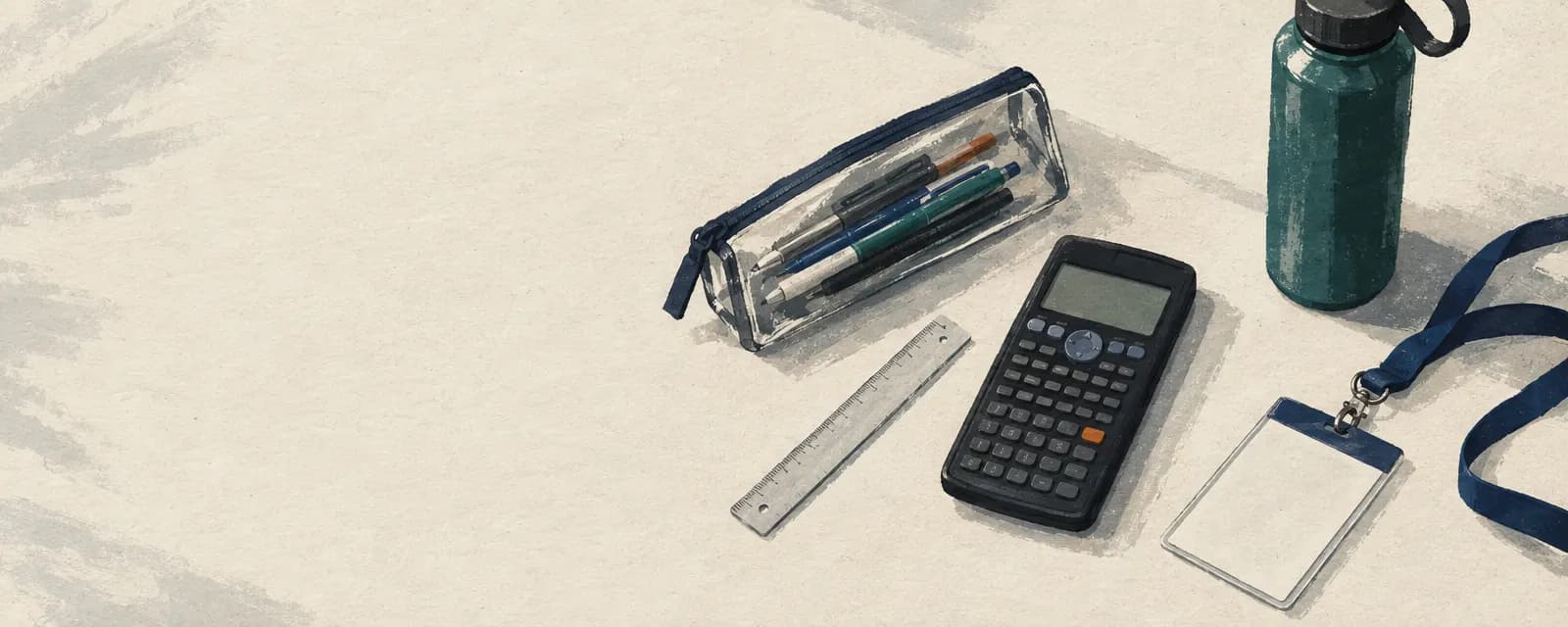
Bring your Notice of External Assessment (NoE) to every exam, your writing gear in a clear sealable plastic bag or clear pencil case, plain water in a clear unlabelled bottle of up to 1500 mL, a basic analogue watch (on the desk, not your wrist) and a TASC-approved calculator if your course allows one. Phones, smart watches, earbuds, any electronic item that can store or share information, food, notes, non-clear bags and correction fluid or tape are banned. Having a banned item can be a breach even if you never use it.
The 2026 TASC written exam period runs from Monday 9 November to Thursday 19 November. Morning exams start at 9:00 am and afternoon exams at 1:30 pm. Everything below comes from TASC's External Assessment Rules, its "What you can bring into an exam" poster and its 2026 Student Exam Guide (linked at the bottom). Your school's TASC Liaison Officer can help with anything that doesn't match.
Your TASC exam kit
- Your Notice of External Assessment (NoE). TASC says you must bring it to every exam. If you lose it, you won't get extra time for the time spent getting a replacement. On your papers, use your TASC ID, not your name or school.
- Writing equipment in a clear, sealable plastic bag or a clear pencil case:
- black or blue pens (TASC's poster says not erasable pens);
- 2B pencils, a sharpener and an eraser;
- highlighters;
- a clear plastic ruler.
- Water: plain water only, in a clear plastic bottle with no label, 1500 mL maximum. It can't be refilled during the exam.
- A watch, if you want one: basic analogue only (not smart, programmable or computerised). It goes on your desk where the supervisor can see it, not on your wrist.
- A calculator, only if your course permits one (see below).
- A printed dictionary, if you want one: a standard English dictionary or thesaurus, or an English-to-other-language one. An other-language-to-English dictionary is only allowed where your exam permits it. Dictionaries can't be annotated or highlighted, and that includes stickers marking your place.
- An asthma inhaler is fine. Any other medication has to be approved as a reasonable adjustment.
Calculators
- Only TASC-approved calculators, and only in exams where they're permitted. Different courses allow different kinds of calculator, so check your course's rules with your teacher.
- All wireless and Bluetooth functions must be disabled.
- You can't borrow or share a calculator, and removable covers and instruction booklets aren't allowed.
- TASC says malfunctions or flat batteries won't be taken into account, so check yours and bring spares.
What's banned
TASC says you can only bring or use what's on its permitted list; anything else is prohibited. Its poster and student guide call out:
- any electronic item that can share or store information, including mobile phones, tablets, smart watches and wireless earphones;
- any food, and any drink other than water (food is only allowed as an approved reasonable adjustment);
- loose notes, papers, books or notebooks, including formula sheets and information sheets unless they're permitted for your exam;
- bags that aren't clear, sealable and plastic;
- correction pens, bottles or tape (like Whiteout or Liquid Paper);
- hats, caps and beanies, unless worn for religious or cultural reasons or approved as a reasonable adjustment.
Supervisors can ask you to put your hood down, take off bulky jackets or jumpers, and empty your pockets. TASC's rules also ban using AI or other technology in a way that isn't permitted.
What happens if you break the rules?
TASC is clear that having an unauthorised item can be a breach even if you didn't use it. Its sample exam room instructions give you a chance at the start to hand over anything you shouldn't have, with no penalty if you do it then. Take it.
Penalties for written exams range from a formal warning, being refused entry or removed from the room, and having items confiscated, up to cancelling your exam result, your course result or all your TASC results for the year. TASC may also refer suspected unlawful conduct to Tasmania Police. You can appeal a penalty within 5 calendar days of being notified.
When to arrive, and when you can leave
- Arrive early. TASC's 2026 Student Exam Guide says at least 15 minutes before the start; its student guide web page suggests aiming for at least 20. Aim for 20.
- Up to an hour late: you're let in, but you don't get extra writing time.
- More than an hour late: you're only let in if your school's TASC Liaison Officer or Principal recommends it, and you acknowledge that your answers may not be accepted by TASC.
- TASC won't make allowances for misreading your timetable, and exams can't be rescheduled because of illness.
- You can't leave in the first hour or the last half hour of writing time.
- Raise your hand if you need the supervisor. At the end, stay seated and silent until you're told you can go, and don't take any paper out of the room.
Preparation time
Every TASC exam starts with an extra 15 minutes of preparation time, on top of the 2 or 3 hours of working time. You can read, highlight or underline key words, and make notes on the notepaper provided (it isn't marked). You can't write any part of an answer in your exam paper or booklet, or use a calculator, until working time starts. See how to use reading time well.
If something goes wrong
Sick before or during an exam? Tell your school (or the exam supervisor, before you leave the room), and see a doctor, preferably on the day. Read what to do if you're sick during TASC exams for how derived exam ratings work and the tight deadlines.
Sources & how we know this
- What you can bring into an exam — Office of Tasmanian Assessment, Standards and Certification (TASC) (2026)
- External Assessment Rules — Office of Tasmanian Assessment, Standards and Certification (TASC) (2026)
- Student Exam Guide 2026 — Office of Tasmanian Assessment, Standards and Certification (TASC) (2026)
- Preparing for exams — Office of Tasmanian Assessment, Standards and Certification (TASC) (2026)
- Exam rules: a student guide — Office of Tasmanian Assessment, Standards and Certification (TASC) (2026)
- Preparing for exams: sample exam room instructions — Office of Tasmanian Assessment, Standards and Certification (TASC) (2026)
- Calculator use in external exams: rules and requirements — Office of Tasmanian Assessment, Standards and Certification (TASC) (2025)
- 2026 exam timetables — Office of Tasmanian Assessment, Standards and Certification (TASC) (2026)
Last updated: 2026-09-28. Rules change. For the official source see TASC.