What to bring to SACE exams, and what's banned (2026)
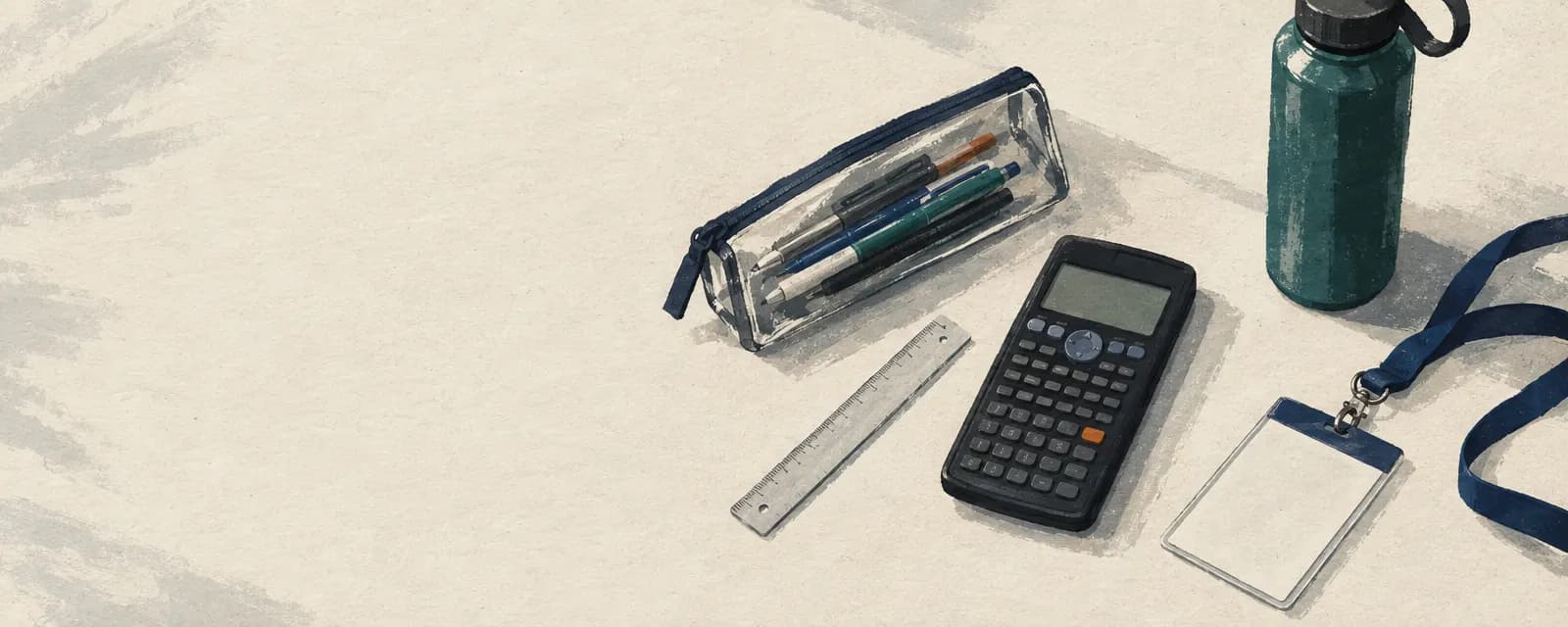
Bring your exam attendance slip to every exam, plus your own printed dictionary if you want one, your notes sheets for the maths subjects that allow them, and an approved calculator for subjects that permit one (no CAS). Phones, smart watches, notes you're not allowed and any electronic device other than an approved calculator are prohibited, and breaking the rules can see your result cancelled or amended. Be at the exam room door at least 15 minutes early.
The main 2026 SACE written exam period runs from Monday 2 November to Friday 13 November (some languages exams are earlier, in October, so check your own timetable). Everything below comes from the SACE Board's exam rules page and its information sheets for schools (linked at the bottom). The SACE Board also prints specific rules on your exam attendance slip, so read yours carefully, and ask your SACE coordinator if anything here doesn't match.
Your SACE exam kit
- Your exam attendance slip. The SACE Board says you must bring it to all your exams. Invigilators may ask to see it (or other suitable ID).
- Your usual writing gear, spares included. Check your attendance slip for any specific rules.
- A printed dictionary, if you want one. English-English, bilingual and monolingual dictionaries are allowed in written exams, but you have to bring your own. It must be a standard printed dictionary (not a subject dictionary, like a physics dictionary), with no extra material such as a thesaurus or maps. Invigilators check dictionaries and remove any notes inside. Electronic dictionaries are not allowed.
- Notes sheets for maths (see below).
- An approved calculator, if your subject allows one (see below).
Notes sheets for maths
Notes aren't generally allowed in SACE exams, with these exceptions:
- General Mathematics and Essential Mathematics: one unfolded A4 sheet (two sides) of your own handwritten notes.
- Mathematical Methods and Specialist Mathematics: two unfolded A4 sheets (four sides) of your own handwritten notes.
They can't include calculator manuals (but you can write out complex key sequences you might need), and they shouldn't be laminated or put in plastic sleeves.
Calculators
- Calculators are allowed in the maths subjects and in a listed set of others, including Accounting, Biology, Chemistry, Geography, Nutrition, Physics, Psychology and Tourism. The SACE Board says calculators are not approved for any other subject's exam, so check information sheet 49 for yours.
- No CAS. Computer algebra systems aren't permitted in external exams.
- Approved graphics calculators include the Casio fx-9860G AU Plus, fx-CG20 AU, fx-CG50 AU and fx-1AU GRAPH, and the TI-84 Plus family (TI-84 Plus, TI-84 Plus C Silver Edition, TI-84 Plus CE and TI-84 Plus CE Python). Any scientific calculator is fine unless it has an external memory source (a USB jack or SD card slot).
- How many: for maths subjects, two approved graphics calculators, or one scientific and one approved graphics calculator.
- Memory: you must clear the memory of scientific calculators. In maths subjects you don't have to clear a graphics calculator's memory; in non-maths subjects you must clear the memory of both graphics and scientific calculators.
- Calculators must be used silently. Leave removable covers and instruction booklets outside.
- The SACE Board says flat batteries or incorrect resetting are not grounds for special provisions, so check yours before exam week.
E-exams
Some SACE exams are electronic. If you have one:
- You'll use the locked-down SACE Exam Browser. iPads and tablets don't meet the minimum requirements, and whether you can bring your own device is up to your school.
- The browser has a built-in Collins English student dictionary, and you can still bring a printed dictionary.
- You can wear your own non-electronic earplugs. For e-exams with audio, wired or Bluetooth headphones are allowed; no other Bluetooth devices are.
- The SACE Board doesn't supply physical scribble paper for e-exams.
- Your work saves every minute, and the SACE Board says no student will be disadvantaged if their device stops working: you can resume on another device with no time lost.
What's prohibited
The SACE Board's rules say you must not have with you:
- any book or notes, apart from permitted materials;
- any electronic device, including mobile phones and electronic dictionaries, apart from approved calculators where permitted.
Invigilators collect prohibited items such as paper, notes, smart watches and mobile phones that students have accidentally brought in. Invigilators also make sure watch alarms are turned off.
What happens if you break the rules?
- If you're found with unapproved materials or devices, your school reports it to the SACE Board, which decides the penalty.
- Students who don't follow the rules can have their exam result cancelled or amended, and can face further penalty, including exclusion from future exams.
- A result of "I" (no result) means a scaled score of zero for that external assessment.
Other rules include not helping or copying from another student.
When to arrive, and when you can leave
- Be at the doors of the exam room at least 15 minutes before the start time. Question booklets are handed out about 5 minutes before the start.
- You can't enter more than 40 minutes after the start or leave until 40 minutes after the start.
- If you arrive late because of misadventure, you may be admitted and given the full exam time if your principal recommends it (a statutory declaration may be needed), on the understanding that your answers may not be accepted by the SACE Board. If you're more than 40 minutes late without an acceptable reason, you can only be admitted on the principal's recommendation, and you must stop writing at the scheduled finish time.
- Hand all your answer books to the supervisor before you leave, and write "BLANK" on the cover of any you didn't use. Don't take any exam materials out of the room.
Reading time
Most SACE exams no longer have separate reading time: the old 10 minutes is built into the exam length (so a 2 hour 10 minute exam is now 130 minutes), and you can start writing or using your calculator straight away. English as an Additional Language and some languages exams still have reading time. Our guide to using the first few minutes well explains how to plan anyway.
If something goes wrong
Sick on the day, or something happened on the way? See a doctor or psychologist on the day of the exam, talk to your SACE coordinator, and read what to do if you're sick during SACE exams. The deadline is short: three business days.
Sources & how we know this
- Exam rules — SACE Board of South Australia (2026)
- Information sheet 49: Written examinations, calculators — SACE Board of South Australia (2026)
- Information sheet 03: Breaches of rules — SACE Board of South Australia (2026)
- Information sheet 31: Rules of assessment for students — SACE Board of South Australia (2026)
- Information sheet 46: Written examinations, instructions to SACE coordinators — SACE Board of South Australia (2026)
- Information sheet 47: Written examinations, invigilation instructions — SACE Board of South Australia (2026)
- Electronic examinations: FAQs — SACE Board of South Australia (2026)
Last updated: 2026-09-28. Rules change. For the official source see SACE Board.