What to bring to HSC exams, and what's banned (2026)
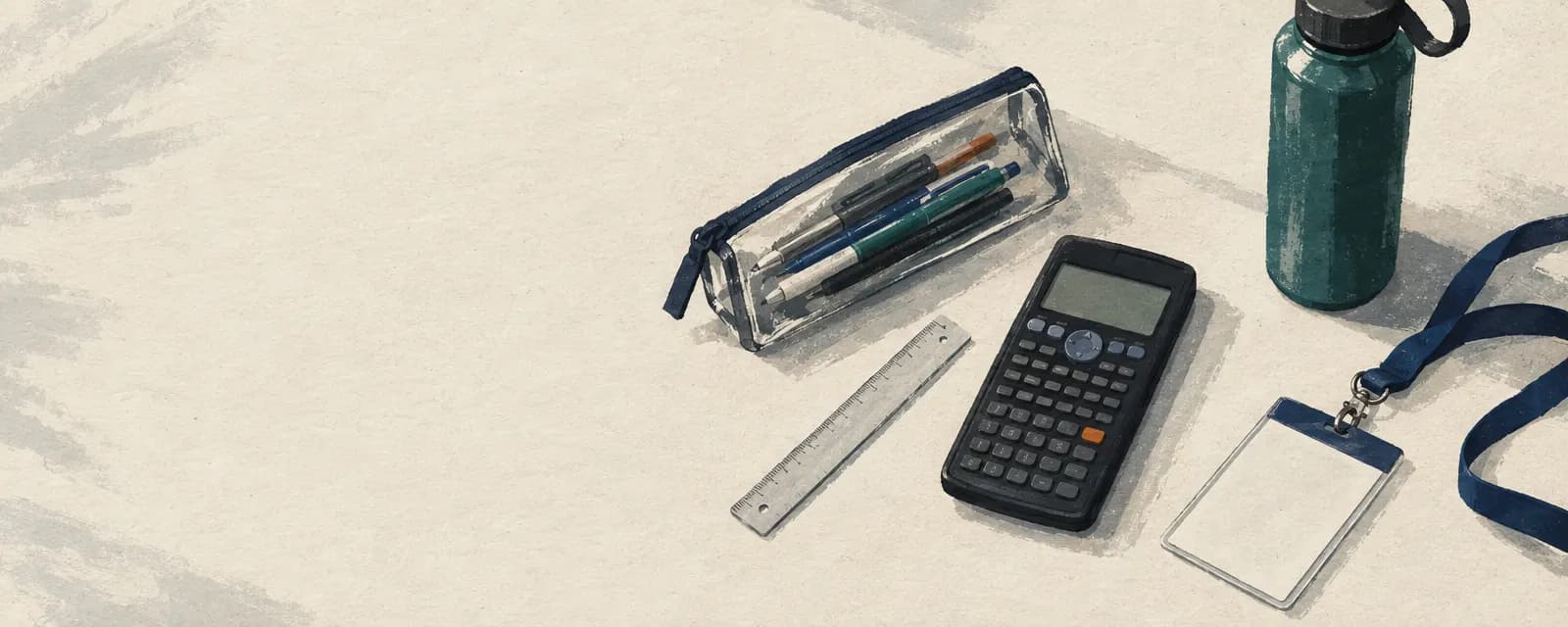
Bring black pens (not erasable) and spares, pencils of at least 2B, an eraser, a sharpener, a ruler, a highlighter, water in a clear label-free bottle, a NESA-approved calculator if the subject uses one, and any subject equipment on NESA's exam equipment list. Phones are never allowed in the exam room, and neither are smart watches, smart glasses, earbuds, notes, correction fluid or tape, or wallets. If you accidentally bring something banned, hand it in before the exam starts and there is no penalty.
The 2026 HSC written exams run from Tuesday 13 October to Thursday 5 November. Every rule below comes from NESA's Rules and procedures guide 2026, its exam equipment list and its approved calculator list (linked at the bottom). If anything here differs from what NESA or your school tells you, they win.
Your HSC exam kit
Pack this the night before:
- Black pens, and spares. NESA says black pens only, no pens with ink that can be erased, and to bring spare pens to each exam.
- Pencils of at least 2B, plus an eraser and a sharpener. Only use pencil where a question tells you to.
- A ruler.
- A highlighter, if you like using one. You can't use it during reading time.
- Water in a clear, label-free bottle.
- A watch, if you want one, as long as it is not a smart or programmable watch. You must take it off, put it on your desk in clear view and not touch it during the exam.
- A NESA-approved calculator for subjects that use one (see below).
- Subject equipment. Check Students Online or NESA's exam equipment list for your exams. Physics, for example, lists an approved calculator, a pair of compasses, a protractor and set squares. Geography lists dividers, a magnifying glass and a piece of string for measuring, among other things.
Make sure it all works. NESA says it will not uphold an illness or misadventure application for equipment failure, so test your calculator and pens before exam week.
You can't borrow equipment during the exam, and NESA warns that sharing equipment can count as collusion. Bring your own spares.
Calculators
Only calculators on NESA's approved list can be used. An approved calculator can't be programmable, have graphing, have CAS (computer algebra) functions or have built-in financial functions. Before you walk in:
- switch it off and reset it;
- leave the lid and any instruction booklet or reference card behind (both are banned).
Heads up for Year 11s reading this: NESA says the approval list it publishes in 2026 is for the 2027 HSC.
Language dictionaries
In language exams, unannotated print dictionaries (monolingual or bilingual) are allowed. Digital dictionaries are not. Dictionaries are not allowed in Classical Greek or Classical Hebrew. During reading time you can read your dictionary, but not write on it or mark it.
Online exams
Enterprise Computing, Science Extension and Software Engineering are sat online. For those you need a supported laptop or desktop with the NESA lockdown browser installed, wired headphones (no Bluetooth), a keyboard and a mouse. Smartphones, Chromebooks and iPads can't be used for any online exam. Check the full requirements with your school well before the day.
What's banned in the exam room
NESA's list of things you must not have with you includes:
- mobile phones (NESA says they are not permitted in an exam room under any circumstance);
- smart watches and other programmable watches, and smart glasses;
- electronic devices, such as tablets, wireless earphones like AirPods, electronic dictionaries and music players (an approved calculator, or wired headphones where allowed, are the exceptions);
- stopwatches;
- paper, printed or written material, including your own exam timetable (ask the presiding officer if you need working paper);
- correction fluid or correction tape (cross mistakes out instead);
- wallets;
- writing on your body, even if it has nothing to do with the exam.
You also can't eat in the exam unless NESA has approved it, for example if you have diabetes.
What if I accidentally bring something I shouldn't?
Hand it in before the exam starts. NESA says students who accidentally bring study notes, a phone or another banned item can remove it without penalty before the exam begins.
After that, it gets serious. Supervisors can inspect your equipment and remove banned items, and they can ask you to leave if you don't follow the rules, and report you to NESA. NESA's penalties can include reduced marks, zero for the exam or cancelling the course, which can make you ineligible for the HSC. NESA even notes that bringing in a phone "as a tool for emotional support" may be treated as malpractice. So check your pockets at the door, every single time.
When to arrive, and when you can leave
- Arrive at least 30 minutes early on the day of your first English exam and for the online exams (Science Extension, Enterprise Computing, Software Engineering). For every other exam, arrive at least 10 minutes early.
- The start time on your timetable is when reading time begins.
- If you're running late, contact your principal and get to the exam centre as soon as you can. If you arrive more than an hour after the start, you can still go in, but you'll need to explain why NESA should accept your responses for marking.
- You can't leave in the first hour or the last 15 minutes, and your school may not let anyone leave early at all.
- Before you leave your desk, complete the Student Completion Record and wait for the supervisor to check and countersign it.
- Return every part of the paper, and write "non-attempt" next to any question you didn't attempt.
NESA also reminds students not to put themselves in danger getting to an exam, for example during bushfires or floods. If something like that happens, contact your principal.
Reading time rules in one line
During reading time you must not write, use any equipment (highlighters included, except in online exams) or mark your paper in any way. Our guide to using reading time well explains how to make those minutes count.
If something goes wrong
Sick on the day, a family emergency, or something that knocked you around in the exam? Tell the presiding officer or your principal straight away, and read what to do if you're sick or something goes wrong in the HSC. The evidence has to be collected on the same day, so it matters that you know the steps before you need them.
Sources & how we know this
- Rules and procedures guide 2026: Term 4 — NSW Education Standards Authority (NESA) (2026)
- Exam equipment list — NSW Education Standards Authority (NESA) (2026)
- Approved calculators — NSW Education Standards Authority (NESA) (2026)
- Breaking HSC rules — NSW Education Standards Authority (NESA) (2026)
- HSC written exam timetable — NSW Education Standards Authority (NESA) (2026)
Last updated: 2026-09-28. Rules change. For the official source see NESA.